



Transportation by Mules
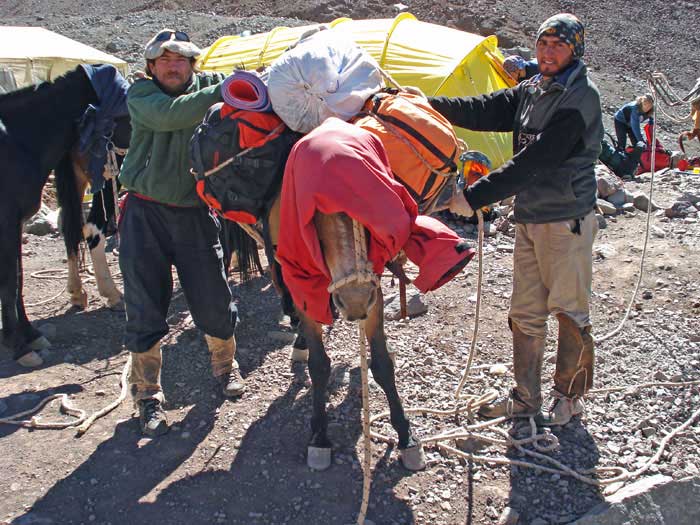
These hardy animals have been used for centuries to carry items over mountain passes. The armies who fought for the freedom of South America in 1817 transported their belongings in this way. Mules are very sure-footed, moving over mountainous terrain with confidence and accuracy. Their strength enables them to carry relatively large loads. Mules are essentially wild animals which is why we have experienced ‘arrieros’ or muleteers on board who know how to manage and care for these important animals. From Puente del Inca up to base camps, mules will carry your belongings. Each mule can carry up to 60kg in weight, with each climber being allocated 30kg (therefore two climbers share a mule). We recommend that you bring a durable canvas duffel bag in which to transport your belongings in this way. Within this outer bag everything should be inside waterproof bags to prevent things getting wet. The mules will carry everything except for each climber’s own personal backpack which only contains the things needed for that day's climbing.
Mules undoubtedly make mountain expeditions more comfortable for climbers. As an ascent on Aconcagua takes over 2 weeks, a large amount of gear is required to heighten the chance of success and all these supplies are too much for men alone to carry. A mule can carry 3 times as much as a man and has much greater stamina over longer distances. The muleteers are in charge of driving, taking care of, loading, unloading and preparing the mules. Some visitors may consider muleteers to be cruel to their mules but these men are very hard-working rural people who live in the mountains and spend their winters herding cattle. Mules are stubborn animals that have to be continually controlled and cannot be coaxed into action. These men are used to working with this type of animal. Each muleteer takes care of three mules. If you speak Spanish it might interest you to talk to the muleteers, as they have been around the area for years and with their breadth of knowledge could give you some useful tips for the ascent. A mule in the mountains is of the same value as a horse, which is considered a precious commodity. The advantage of a mule over a horse is that a mule will generally fend for itself and eat almost anything.
Issues Regarding Use of Mules
Transport on mules can be very risky and rather complicated. The muleteers' expertise and the tameness and docility of the animals are key factors in assuring the safety of the whole team. There are other potential risks, unfortunately, like the crossing of rivers (especially after winters with frequent and heavy snowfall) when animals may be washed away by the water currents and, on occasions, drown, with a consequent loss of equipment. In Argentina, no insurance company covers the risks mentioned above. We suggest that climbers insure their equipment in their country of origin, for protection from eventual loss in case of an accident involving a mule. Also, so as not to have to transport clothes or other items not used on the mountain, we offer our clients a safe keeping service at our base, Los Puquios, at no extra cost.
In spite of the dangers that are present for mules as well as for anyone who undertakes a summit attempt on Aconcagua, we have been recognised by the Cullunche Foundation as taking good care of our mules. We are the only expedition company that offers its own grounds of more than 6 hectares. These are exclusively used for our buildings and premises, as enclosures to keep our animals and as camping space for climbers. The whole compound is located only 1500m east of Puente del Inca. Our name, “Los Puquios” which translates from the Quechua language as “pure water spring”, is clearly noticeable opposite the Andinistas Cemetery where those who have died on Aconcagua lie, and between the small villages of Los Penitentes and Puente del Inca. You will find our representatives in both villages but Puente del Inca is busier, with different lodging options, an international telephone service, restaurants, a post office and fast food bars. Our staff carry out coordination work, like receiving, dispatching and storing transported equipment, which is brought by mules. We have radio communication to reserve a mule upon your return and from any point on the mountain.
For safe keeping of personal belongings we issue a deposit form prior to starting the ascent which is officially letter headed and numbered. It gives details about quantities, characteristics and weight of any bags and containers checked in. Under this system, there will be no confusion regarding each person’s belongings. Around the Park area, there are some transport service providers who charge very low prices, especially when coming back from the base camps. We feel it is our obligation to warn climbers against using these low cost services since they do not always assure good transportation. Moreover, it is difficult to find the physical location of these company bases in order for us to make timely deliveries of climbers’ equipment. We would like to draw attention to the fact that saving a few dollars in transport in this way will not actually lower costs. On the contrary, it is a common sight to see climbers wandering between Puente del Inca and Los Penitentes, asking for their gear.
Our main services include:
- Assistance in the packing of your load and the protection of your equipment and food.
- Load deposit at Puente del Inca and base camp.
-
Vehicle transportation from your lodging area (Puente del Inca or Los Penitentes) to the starting point.
- Assistance crossing the Vacas River with mules.
- Latrine tents at base camps.
- Free removal of litter/waste.