Medical Treatment
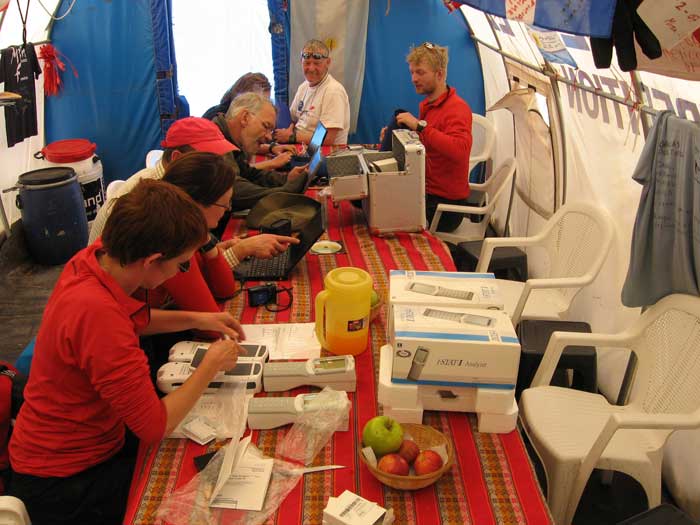
In the official season of Aconcagua Provincial Park (November 15th to March 15th) there is a free medical assistance service which is sponsored by the government of Mendoza. It is located in the centre of Plaza de Mulas. It is advisable to have daily general checks for oxygen saturation in the blood and to spot any illnesses that might arise in good time. In Plaza Argentina this service is also available but only during the high season (December 15th to January 31st).
Oxygen is carried in the blood by haemoglobin molecules and in a person who is at rest at sea level the saturated oxygen level should be close to 100%, most commonly in the high 90s. The higher altitude a person gains the lower this saturated oxygen content goes and it is when it falls too low that serious health problems may arise such as pulmonary and cerebral oedemas. At Aconcagua base camps (around 4200m), a climbers saturated oxygen level should be in the high 80s, over 90 is even better. If a measurement of 80 or less is made the individual will be told to remain at base camp, rest and drink plenty of fluids. If the measurement is below 70 at this altitude, the climber will inevitably have to descend.
Most of the health problems that arise on Aconcagua come as a result of acute mountain sickness (AMS). The severity of this condition can vary greatly - almost everybody who climbs to altitude will feel some of its effects - but some people may be more seriously affected and may feel so ill that they have to descend. People are more likely to get AMS if they do not take enough time to ascend to high altitude and do not prepare their bodies in the correct way. Drinking lots of fluids is one way of helping to combat AMS as well as ensuring that you are in excellent physical shape prior to beginning the climb.
The doctors and medical practitioners that work on Aconcagua are well experienced in dealing with sufferers of AMS. In spite of what is commonly thought, prescription drugs such as Diamox are not that beneficial in combating AMS. The doctors on Aconcagua are reluctant to use such drugs as they know that although Diamox may make a person feel better in themselves, what is really happening is that the negative symptoms are being masked by the drug rather than being prevented altogether. Common minor effects of altitude may be loss of appetite, tiredness, disturbed sleep and unusual dreams, nausea, dizziness or light-headedness, feeling cold and feeling panicky.